Showing posts with label David Shearer. Show all posts

An innocent mistake, or a Freudian slip?

With speculation that David Shearer could be restored to his former role of leader of the Labour Party (although why would he want it?), we're wondering as to the cause of this Bay of Plenty Times headline:


Did someone at the BoP Times (or at APN's centralised production centre) make a cock-up, or does someone have inside information of an impending coup or even a fait accompli?

The plot thickens...

The headline no leader wants to see

In just 64 days, New Zealanders will go to the polls. And with the 2014 General Election looming large in their thinking, no political leader would want to wake up to a headline like this; Cunliffe a Labour liability, poll shows.

The headline tops a story written by veteran Fairfax political journalist Vernon Small. It begins thus:

Labour would get an immediate lift in the polls if it dumped leader David Cunliffe, a new poll suggests.
The stuff.co.nz/Ipsos poll reveals that Cunliffe may have become Labour's biggest liability, with a significant number of voters saying they would be more likely to vote for Labour if someone else were leader.
Click here for full poll results in graphics.
The effect is sizeable, making a 13.5 percentage point difference to Labour's vote.
Although a similar effect is seen on National when asked the same question about John Key, it is much smaller.
The finding will plunge Labour further into crisis after yesterday's poll result cementing Labour's support in the mid-20s.
Privately, Labour and the Greens now acknowledge that it would take an unprecedented swing against National to force a change of government on September 20. 

That last sentence is telling. For all the bullish talk and the relentless positivity in public, politicians are inherently realists when it comes to polls. Of seven polls in the last six weeks, only one shows Labour at greater than 30% support; the Herald DigiPoll of mid-June had Labour at a whopping 30.5%, and even that poll had National with enough support to govern alone.

Vernon Small continues, hinting at some deep concerns within Labour's caucus that make a mockery of David Cunliffe's pronouncements of unity:

Some Labour MPs were yesterday privately canvassing leadership options, even at this late stage.
But they believe Labour would be even more severely punished by such an outward sign of panic.
Labour's focus now has shifted to protecting its vote from further erosion, and preserving the seats of some of its up-and-coming stars, including Andrew Little, seen as a future leadership contender, and former teacher Kelvin Davis.
Even some of Labour's seasoned hands, including finance spokesman David Parker and frontbench MP Jacinda Ardern, could be at risk of losing their seats in Parliament if party support sank much lower.
Labour MPs are clearly convinced the party has suffered in recent weeks because of a series of headlines that took the focus away from what they saw as a successful alternative economic policy and Budget plan and a suite of popular education policies.
Those distractions included Trevor Mallard's moa resurrection, Nanaia Mahuta's musings about te reo in schools, Little's comments about the reversal of the burden of proof in relation to consent during rape trials, and being drawn into the Dotcom saga.
But they also included Cunliffe's own apology for being a man and his suggestion that opponents in the party were scabs - as well as what MPs saw as unfair treatment of his connection to property developer Donghua Liu. 

Small's revelation that Labour's focus has shifted from winning to self-preservation is telling, but not entirely unexpected; check out these photographs:


Sue Moroney has blanked out the "official" Labour Party authorisation on her billboards, and hand-written her own. As you can see in the middle photo, she has also obscured the Labour Party logo. Interestingly though, Sue Moroney is a David Cunliffe loyalist, yet she seems to want to disassociate herself from the party he leads.

And apart from the fact that Clayton Cosgrove is NOT the MP for Waimakariri as his billboard implies, his billboards are interesting to say the least. It looks as though he is distancing himself from the party under Cunliffe's leadership, as he did in 2011 when he lost Waimakariri to Kate Wilkinson. Unsurprisingly, Labour lost the party vote in Waimakariri by more than 12,000 votes, but ironically Cosgrove returned to Parliament via the Labour list, having not campaigned actively for party votes!

Labour is in crisis; so much crisis that there is even talk of David Shearer returning as leader. David Cunliffe is not going to be a happy leader when he returns from his holiday.


Labour playing catch-up on education policy

This weekend was supposed to be all about the Labour Party releasing some bold, union-driven education policy. Instead it has been all about moa, Mr Cunliffe being sorry for being a man, and other senior Labour MP's expressing their solidarity with David Cunliffe for being sorry for being a man.

And then came the ultimate indignity. Labour has been sledged by Associate Education Minister Nikki Kaye in this presser for recycling policies; check this out:

Nikki Kaye

5 July, 2014

Labour playing catch up on 21st century schools


Associate Education Minister Nikki Kaye says Labour has clearly not done its homework in the education area and is promoting "new ideas" that have already been put in place by National.
“Most of what Labour has announced today is already being delivered by the Government through its 21st century schools programme. We have a massive build plan underway to modernise school facilities, upgrade school broadband networks and partner with communities to provide digital hubs through those networks. Our Ultrafast broadband and rural broadband initiatives are delivering fibre broadband with uncapped data to nearly every school in New Zealand.
"Labour's announcements today prove they have no idea what is already going on."

Nikki Kaye goes on to berate Labour over initiatives it has proposed, many of which are already happening:

Labour want to put money into professional learning development for ICT over the next few years. National has already invested $35 million in Professional Learning and Development, specifically targeted at learning with digital technologies.
Labour want to build an unspecified number of new schools and classrooms by 2030. Under the National government, hundreds of millions of dollars has been spent building new classrooms and upgrading older schools with the help of the Future Investment Fund, which Labour opposes. National has opened 12 new schools in the past three years in areas of growth.
And Labour wants to enable students to access the internet at home. Last year, National announced a change in policy to enable schools to extend their school internet to the surrounding area so students and families can access the internet from home.
Ms Kaye said the device subsidy programme also did not appear to have been thought through.
“There is an amazing lack of detail. Are they really going to make the subsidy available to every one of the 580,000 children in years 4 to 13? How do they plan to deal with rapid changes in technology? Is the plan limited to one device throughout the period of the student's time in school? If not, how many devices? How are they planning to deal with the interest costs? All these questions must be answered.

Nikki Kaye's questions are absolutely valid questions, and they are ones Labour must provide immediate answers to. Otherwise this looks just like policy made on the hoof, and we have already seen a number of examples this year of poorly conceived Labour Party policy not standing up to scrutiny. However attractive the policy may seem on the surface, the devil will be in the detail. And as has been seen over and over this year, Labour is not a detail party.

There's a final, school-related sledge from Nikki Kaye:


“Labour has simply not done their homework. It really does make you wonder what they have been doing over the past six years.
“Our Future Focussed Learning report, sets out the direction the National government is going.
“Labour really needs to research what's happening and catch up,” Ms Kaye says.

One of the most interesting aspects of the laptops and iPads policy was a comment in the Herald story on the announcement yesterday; check this out:

It is based on the Manaiakalani Trust programme in Tamaki, which works with 12 lower decile schools to provide students with a netbook and 24/7 access to the internet.

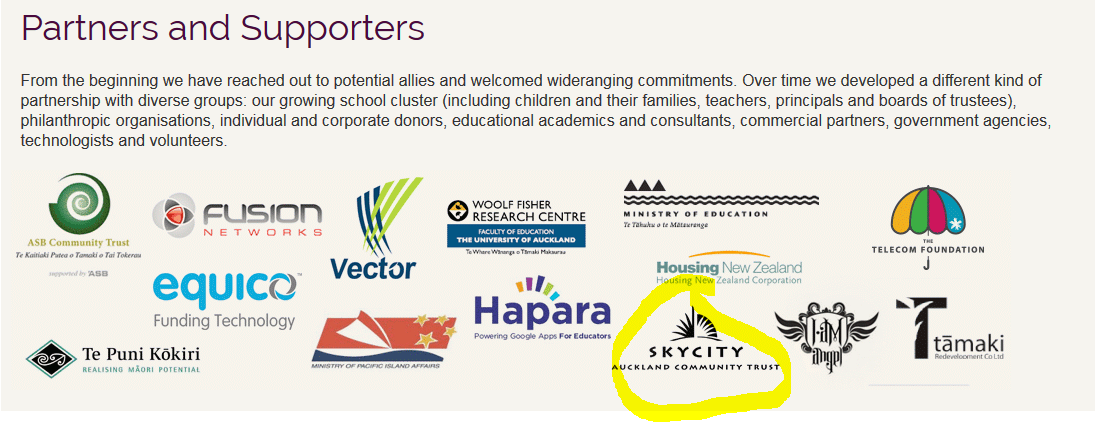
Interestingly, the Manaiakalani Trust is essentially a public-private partnership, which receives considerable support from corporates. And even more interestingly, look who one of those corporates is:


Now we don't have any problem whatsoever with SKYCITY Auckland Community Trust supporting the Manaiakalani Trust to improve educational outcomes for vulnerable New Zealand children. In fact we think it's commendable, and socially responsible. But given the amount of hot air expended by Labour MP's towards SkyCity in the past, not to mention the angst caused to Labour leader David Shearer last year when it was revealed that he and a number of Labour MP's accepted corporate hospitality from SkyCity at Eden Park. 

This policy release from Labour gets a resounding "not achieved". It has some good points, but in trying to be all things for all people, Labour has missed the mark by some distance.


Behind closed doors

The National Party holds its election-year conference in Wellington this weekend. On the back of a number of positive polls National Party MP's and members will hit conference in a bouyant mood. The media will doubtless note the mood of conference, as they will be there in good numbers.

It's a different story next week when Labour holds its own election-year congress, as opposed to a conference. Changing the name has given Labour an excuse to keep the media away, as Andrea Vance reports on Stuff:

The Labour Party will close most of its election-year conference to the media.
The three-day meeting is due to take place in Wellington on July 4 to 6.
Speeches by Labour leader David Cunliffe, president Moira Coatsworth, and Australian Labor leader Bill Shorten will be open for reporting. Cunliffe is expected to unveil new policy.
But a programme, circulated to media last night, shows meetings on Friday and a training day are closed to all but members.
Previously, most of the event has been open. However, rank and file remits - such as a quota for female MPs and on the Trans-Pacific Partnership - have brought internal divisions into the public arena.
Tensions over former leader David Shearer boiled over in 2012, with Cunliffe demoted for failing to demonstrate his loyalty.
Nationals' conference begins in Wellington today, with a major policy announcement from Prime Minister John Key expected on Sunday.
Much of the Green Party conference, held in the Hutt Valley this month, was also members only. 

Andrea Vance refers to tensions at past Labour Party conferences. We have had a couple of conversations with people closely linked to the Labour Party who have told us that things are not well. Tensions are spilling over as the party's many factions battle one another for the inevitable post-election blood-letting.

We reckon that's the reason that Labour is keeping the media away next weekend, from everything except what will be carefully stage-managed appearances by David Cunliffe and his Australian Labor counterpart. And from David Cunliffe's point-of-view, there's a rich irony in holding congress/conference behind closed doors.

...beaming like a cat who'd found a litre of cream...

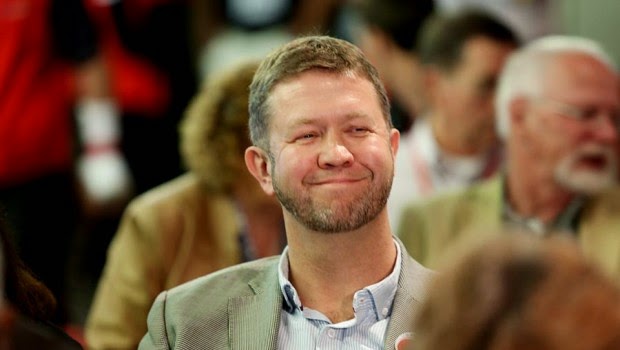
Two years ago, as he chipped away at David Shearer whilst beaming like a cat who'd found a litre of cream, David Cunliffe lapped up the media attention. Now of course, the boot is on the other foot, and Mr Cunliffe himself is being white-anted by those who see their personal ambitions as more important than the party's performance twelve weeks from today. 

Unfortunately, excluding the media won't stop the negative reporting. If anything, the media pack is likely to give Labour a tougher run because it perceives that the party is trying to control what is written. Labour has so few friends at the moment, that running the risk of alienating the media is a very dangerous strategy.

But that's next weekend. This weekend is about the National Party, and John Key and his team. And the media will be there in force. What a stark contrast to Fortress Labour.

A reader e-mails...

This was in our inbox when we first logged on this morning:

Hi

Understandably there's been a lot of media speculation on the future of Cunliffe after "the letter".

I wonder if it's a coincidence that, in the last two or three days, sponsored posts from David Shearer have been turning up in my Facebook news feed.

Cheers,
 
Is David Shearer being lined up by forces in the Labour Party to "take one for the team", and lobby for his old job? Given that his poll ratings, seen at the time as dire, have actually been consistently higher than those Mr Cunliffe is enjoying, it can be argued that Mr Shearer was harshly done by. And to reassume the leadership from the man who white-anted him at every juncture would be sweet irony.
 
And those who are in danger of being out of work come 21st September might look at the suggestion and think "Well, it worked for Kevin Rudd". The threat of unemployment can be a powerful motivator...
 

White-anting in Labour? Surely not...

Is David Cunliffe being white-anted again? You'd have to wonder after reading Andrea Vance's story on Stuff:

Senior Labour Party MPs have used social media to attack the alliance struck between Mana and the Internet Party.
Former leaders Phil Goff and David Shearer, and Rimutaka MP Chris Hipkins, are among those who have objected to the deal. It could see MPs from Kim Dotcom’s fledging political vehicle enter Parliament on the ‘‘coat-tails’’ of a victory for Hone Harawira in Te Tai Tokerau.
The strong opposition from within Labour could make post-election coalition talks tricky.
Goff says he feel strongly about Dotcom’s ‘‘pure political opportunism’’, citing his previous donations to ACT MP John Banks, now the subject of a court case. ‘‘He wants to be able to influence and control politicians.’’
Goff says he was previously ‘‘very critical’’ of National for exploiting MMP and failing to implement recommendations from the Electoral Commission to abolish the provision.
‘‘I’m scarcely likely to endorse another rort ...I’m being entirely consistent,’’ he said.
Goff says he made his feelings clear to the Labour caucus. ‘‘It will be the decision of the party leadership...but I see problems in creating a coalition where the philosophies and principle of people that you are trying to enter into a coalition with is unclear because they seem to be coming from diametrically opposed positions.’’
Those  views were also reflected in a passionate Facebook post at the weekend. Shearer also used the social media site to write that although he wished the Internet-Mana ‘‘marriage’’ well, he knew ‘‘it’s going to end badly.’’
And on Twitter last week, Hipkins posted: ‘‘The good old days, when political parties formed from movements. Now all it takes is a couple of million and some unprincipled sellouts.’’ 

Now getting all high-and-mighty and having an attack of principles is one thing, but it's not something you'd usually associate with the Labour Party. But Ms Vance makes a very interesting point:

All three MPs were linked to the Anyone But Cunliffe [ABC] faction - who were opposed to David Cunliffe assuming leadership of the party. However, a Labour source played down talk of more division, saying all three were close to Te Tai Tokerau candidate Kelvin Davis.
Davis himself posted on Twitter: ‘‘Bro, I think of the people of Te Tai Tokerau, not Sergeant Shultz.’’  He was referring to Dotcom’s German origins.
A spokesman for Labour said Cunliffe was ‘‘off the grid’’ and not available for comment. 

Kelvin Davis is rapidly emerging as a lightning rod for the ABC faction, which as well as the three chaps named above includes the likes of Annette King, Trevor Mallard and Clayton Cosgrove. 

There's a test coming for David Cunliffe's leadership of the Labour Party. Will he support Kelvin Davis wholeheartedly in an attempt to wrench Te Tai Tokerau from Hone Harawira's grip? Or will he take the path of least resistance, and give MegaMana an armchair ride into Parliament by campaigning softly in the far North? 

Mr Cunliffe is on a hiding to nothing here. He is already deeply unpopular with a large portion of his caucus. But he will also need every possible coalition option if he is to have any chance of forming a government after the General Election.

No one said it would be easy...


Shane's last day

Shane Jones will deliver his valedictory speech today in Parliament.

We've just seen him interviewed on the TVNZ Breakfast programme. He recounted his maiden speech to Parliament, describing how a copy had to be screened by Helen Clark then Speaker Margaret Wilson to ensure that it was of sufficient quality. Jones described his maiden speech as "a bit wooden", but has promised that today's speech will have a lot more personality!

Mr Jones has been something of a character, and with his views on advancing the aspirations of Maori through economic development (including drilling and mining) left him offside with many of his colleagues. At times he has looked to be a square peg trying to fit into a round hole in the Labour Party.

It remains to be seen whether Shane Jones will fire any parting shots at his about-to-be former colleagues. He made one interesting comment on Breakfast; that he had a lot of time for former Labour leader David Shearer, and that he believed that Mr Shearer's appeal to the public would have grown had they had the opportunity to get to know him better. Is that a hint that David Cunliffe's systematic undermining of David Shearer may get a mention?

We look forward to Shane Jones' E noho rā speech early this evening, and wish him well for a future away from the cut and thrust of Parliament.

Watkins on Cunliffe

The Fairfax-Ipsos poll came out last week, and it's fair to say that it wasn't good news for David Cunliffe and the Labour Party he leads. 

One aspect of the poll we didn't touch on when we blogged about it on Wednesday was the Preferred Prime Minister rankings; here they are:


David Cunliffe's PPM rankings are poor; they're in David Shearer territory, or worse. And whilst Labour's polling was at just under 30%, Mr Cunliffe's PPM ranking isn't even half that, which means that more Labour voters DON'T rate David Cunliffe as their choice of PM than do. That's extraordinary. So Tracy Watkins has been drilling down through the numbers:

Will the real David Cunliffe please stand up?
That's the message from experts who claim the Labour leader is failing to connect with the voting public because he's not being true to himself.
It's a sentiment reflected strongly in the latest Stuff.co.nz/Ipsos political poll in which people were asked to play a word association game with Cunliffe and Prime Minister John Key.
Asked to sum up the leaders in one word, people opted for "good" when describing Key, but words included confidence, arrogance, charismatic, leader and a suite of words lumped together as "profanity".
For Cunliffe, words like untrustworthy, arrogant and shifty were more likely to be used along with trying, promising and inexperienced.
However, the poll showed visibility is be an issue for Cunliffe, with 20 per cent saying they thought "nothing" when Cunliffe's name came up; compared with 3 per cent for Key.
While Key got 43 per cent positive comments, 30 per cent negative and 27 per cent neutral or nothing, Cunliffe got about 6 per cent positive, 25 per cent negative and a whopping 69 per cent neutral or nothing. The results reinforce the impression that Cunliffe is still struggling to connect with voters. 

We find it interesting that people see David Cunliffe as "inexperienced". He has, of course, been in Parliament longer than John Key, and served as a senior Minister in the Clark administration. He had enough experience to undermine Mr Shearer's leadership.

So Tracy Watkins turns to John Key's former media trainer for some perspective, and to a media professional who has actually worked with Mr Cunliffe:

 
Former TVNZ political commentator turned media trainer Bill Ralston said Cunliffe came across like he "doesn't know himself".
"He always appears to be acting. You know, ‘I'm going to be angry now, I'm going to be funny now, I'm going to be serious'. I don't know what or who the real David Cunliffe is but we haven't seen him yet. It's that inauthenticity that's the issue. He just is not pitching himself as a normal person."
Ralston, who helped train Key, said the Prime Minister and New Zealand First's Winston Peters were leaders who had "clearly identified characteristics and personalities - you can almost guess what they are going to say or do next whereas Cunliffe, there's something that just doesn't ring true".
Cunliffe, who at times proved he had the ability to connect, was a thoughtful man who was likely to be over-analysing problems, he said. "He shouldn't try to be anything else other than himself."
Media trainer Brian Edwards, who has worked with Cunliffe, said the Labour leader was coming across poorly "which is curious because in the past he's come across very well indeed. He doesn't look relaxed, he doesn't look spontaneous, he looks like he is reciting extended sound bites that he has been given by advisers."
This was likely down to poor ratings and a failure to gain traction with the public which affected an MP's confidence and tended to make people over-correct. It seemed this had forced Cunliffe to over-prepare and use scripted responses at a time when it was better to wing it. "You can have this problem of too many voices. You're given all this advice and you end up with scrambled brains."

Both Ralston and Edwards are right. With John Key, what you see is what you get, and you know what that's going to be. Key is as comfortable as a Prime Minister as he is as a husband or a father, and draws people in. Even those who oppose him acknowledge his ability to comment with New Zealanders from the board room to the workplace.

David Cunliffe on the other hand is an enigma. The David Cunliffe who delivered the Budget speech on Thursday was a far cry from the David Cunliffe at home with John Campbell on Monday night. Cunliffe confuses people with his different messages to different audiences.

Is authenticity a skilled that can be acquired? We don't know, but even if it is, we doubt that David Cunliffe can acquire it before the election campaign begins in earnest. We close as Tracy Watkins began; will the real David Cunliffe please stand up?


Quote of the Day - 17 May 2014

We won't copy vast tracts of Fran O'Sullivan's excellent column in this morning's Herald. We simply suggest that you go here and have a read for yourself.

But this portion stuck out, and is our Quote of the Day (with our emphasis added):


These post-Budget lunches are a marquee event on the business calendar. They are where Key not only explains the Budget but also charts the future in a compelling way designed to engender confidence so business people keep on investing, venturing out into the world to tackle tough markets - and employing staff.
The protesters outside the Sky City Convention Centre didn't get this.
The people who slagged off the guests (for instance - the business organisation leader accused of being a "bloated capitalist") don't seem to get it that business success ultimately underwrites jobs.
The protesters disregard the fact that many New Zealand businesses were put through the wringer by the Global Financial Crisis. People have worked hard to get their firms on to a sufficiently sound footing that they are now confident enough to take a few risks and grow their businesses.
It's a good space for New Zealand to be in.
The protesters were so dumb that they hadn't worked out that the business guests who openly walked past them to take another route into the centre were doing so for a purpose.
Instead they charged a door that was never going to be opened to them or anyone else.
This misjudgment is not confined to protesters.

Fran O'Sullivan is spot on. The protestors yesterday seem to have forgotten that the Budget invests $500m into families via  a range of measure. There wasn't much in it for the "bloated capitalists" who do most of the employing in New Zealand. As one wag put it yesterday, that's what happens when you organise the post-Budget protest pre-Budget!

And Labour has misjudged John Key ever since he entered Parliament almost twelve years ago. The underestimated him as he became National's Finance spokesman where he frequently got the better of Michael Cullen, and when he became Leader of the Opposition. 

Helen Clark thought that the Leaders' Debates against Key in 2008 would be a doddle. Instead it was she who lost the plot, famously accusing the PM-in-waiting of having to shout down his family at home. Key saw of Ms Clark, followed in quick succession by Phil Goff and David Shearer, whilst David Cunliffe shows no signs of having learned anything.

Long may the Labour Party continue to misjudge and underestimate John Key.

Small on the Jones "cluster failure"


Vernon Small is one of the more senior members of Parliament's Press Gallery. He has seen more MP's come and more MP's go than most of us have had hot dinners. So he's not given to going overboard.

That makes his column in yesterday's Dominion-Post even more noteworthy. Under the heading Church collapsed? Buy a house Small opines:

Helen Clark would have lowered her voice and with a hint of authority - and a side order of menace - drawled "it's time to move on".
Labour leader David Cunliffe must be hoping he can move the party, and the political agenda, on after what is surely the heart of darkness of his political year.
If things could get any worse than the cluster failure around Shane Jones' sudden departure to work for a government he was supposed to want out of office, it is hard to see what they could be.

When Mr Small says "cluster failure", we're pretty sure that he means a variant of that phrase, which also starts with "cluster", followed by the letter "f". But the Dom-Post is a polite newspaper, and such a turn of phrase might be frowned upon by Small's editor. However, we all get the picture.

And it has been a shocker of a week for David Cunliffe and his party. Shane Jones quite literally lobbed the electoral equivalent of a hand grenade into Labour's War Room, and the party's handling of the issue is deserving of the "clusterf#ck" label.

Small continues:

The danger for Cunliffe, in the wake of Jones' departure, is that with some in the party wading knee deep in vitriol it will spill over into civil war, revisiting the divisions of the 2012 annual conference. (That's the one where according to some Cunliffites the media fabricated Cunliffe's challenge to David Shearer's leadership.)
Already the same divisions are surfacing. On one side there are the "good riddance to Jones" merchants who seem to believe the broad church party would have a wider appeal if its MPs came from a smaller chapel. It sometimes seems they would rather people - voters - changed their ways rather than the party appealed to a broader array of views.
On the other side are those who lament the loss of Jones' appeal to Maori, soft centrist or conservative National voters but use his supposed straight talking - too many "geldings" in the party etc - to attack identity politics.
At times it becomes indistinguishable from prejudice and downplays the strong strand of liberal egalitarianism and concern for human rights at the party's core. Both axes seem to think tolerance is essential, as long as you agree with me.
Cunliffe's task is to heal those wounds yet again - as Clark mostly did after her messy coup against Mike Moore in 1993 - and get the party back to its core messages. There are, after all, only 20 weeks till polling day.

If a week is a long time in politics, the 20 weeks until the election must seem like an eternity to David Cunliffe. His party is in disarray, his policy launches have been botched, his party's social media efforts (including his own) have been ridiculed, and now his best-performing MP can see that there is not going to be much chance of a seat at the Cabinet table after 20th September.

The wounds within Labour are deep, and mere Band Aids will not suffice. Helen Clark, Phil Goff and David Shearer all resisted major surgey, but now that may be the only option Mr Cunliffe has left.


Older Posts ►
 

Copyright 2015 Drunkethic: David Shearer Template by Drunkethic Template. Powered by Blogger